


A commercial VR paraglider simulator is quoted per unit rather than sold at a single list price, because the final figure depends on the number of seats, the motion system, the game content, shipping distance and your local voltage. The machine itself is only part of the budget. A realistic plan also covers freight, import duties, installation, spare parts and a small reserve for new content. Whether the investment pays back comes down to three numbers: your ticket price, how many riders you can cycle through per hour, and how many hours of the day the seats are actually occupied.
This guide breaks down each cost item, shows the real specifications of two Vart flight-style simulators, explains the space and power you need, and walks through a transparent payback calculation you can rerun with your own numbers.
How Much Does a VR Paraglider Simulator Cost?
Vart does not publish a fixed price for the VR Paraglider Simulator because the configuration, destination and delivery terms change the total. What you can plan for is the structure of the cost:
| Cost item | What it covers | Notes for budgeting |
|---|---|---|
| Simulator unit | Motion platform, seats, effects (wind, mist, vibration), audio, control system | The largest single item. Quoted ex-works or FOB Guangzhou |
| VR headsets and games | Customized Pico Neo 3 headsets and the pre-installed game library | Included in the standard configuration. Ask how content updates are handled |
| Packing and freight | Wooden crate, sea or air freight, destination port charges | A 750 kg machine ships best by sea. Air freight costs far more |
| Import duty and taxes | Customs duty, VAT or GST, brokerage | Varies by country and by product classification. Confirm with a local customs broker |
| Installation and training | Assembly, power connection, calibration, operator briefing | Remote video support or an on-site engineer, depending on the agreement |
| Spare parts and maintenance | Headset straps, seat belts, wear parts, cleaning supplies | Budget a small yearly reserve and ask for a recommended spare parts list |
| Venue fit-out | Floor protection, signage, queue area, ticketing, insurance | Specific to your site and local rules |
A clear way to compare quotes is to ask every supplier for a landed cost: the total delivered, installed and ready to operate at your address. A low ex-works number can turn into a high landed cost once freight and duties are added.
What Affects the Price?
Number of seats. Vart’s VR Paraglider Simulator carries 2 players. The 3-seater VR Parachute Simulator carries 3 players with independent control. More seats raise the unit price but also the revenue per session.
Motion performance. The paraglider platform offers up to 800 mm of vertical drop and 13 degrees of left and right tilt. The parachute simulator offers 1,100 mm of vertical drop and plus or minus 30 degrees of roll. A larger stroke means a heavier, more powerful mechanism.
Effects package. Wind fans, rain mist, seat vibration and surround sound add immersion and also add cost and maintenance points.
Content. The paraglider simulator ships with 7+ games. The 3-seater ships with 12+ VR flight titles. Custom or branded content is quoted separately.
Voltage and certification. Both machines are specified at 220V/50Hz. If your venue runs on a different voltage or frequency, or your market requires specific certification, confirm this before ordering.
Order quantity and delivery terms. Multi-unit orders, mixed containers and shipping terms (FOB, CIF, DDP) all change the final number.
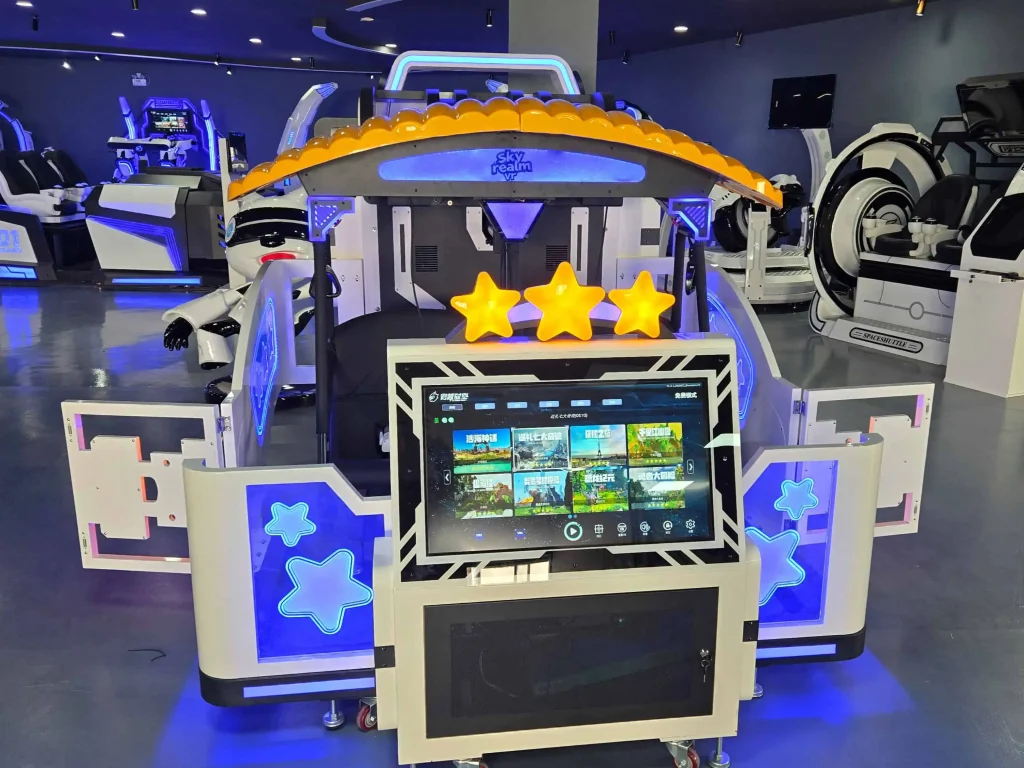
Two Models Compared
The table below uses the specifications published on each product page.
| Specification | VR Paraglider Simulator | 3-Seater VR Parachute Simulator |
|---|---|---|
| Players | 2 | 3, independent control |
| Vertical drop | Up to 800 mm | 1,100 mm |
| Tilt | 13 degrees left and right | Plus or minus 30 degrees roll |
| Dimensions (L x W x H) | 3,000 x 2,042 x 2,055 mm | 2,500 x 2,500 x 3,200 mm |
| Footprint | About 6.1 m² | 6.25 m² |
| Power | 4.0 kW, 220V/50Hz | 9.0 kW, 220V/50Hz |
| Weight | 750 kg | 950 kg |
| Headset | Pico Neo 3 custom version | Customized Pico Neo 3 |
| Games | 7+ | 12+ |
| Player height | 1.2 m to 1.9 m | See product page |
| Effects | Wind, rain mist, vibration feedback, 360 degree surround sound | Velocity-synced wind, seat haptics, 3D surround sound |
If your venue is smaller or you want to start with one attraction, the paraglider is the lower-power option. If you have steady group traffic, the 3-seater gives you more riders per cycle on almost the same footprint.
Space and Power Requirements
Floor space. The paraglider needs about 3.0 m by 2.04 m, and the 3-seater needs 2.5 m by 2.5 m. That is the machine only. Add roughly 1 m of clear space around it for safe entry and exit, plus room for an operator position and a short queue. A practical planning area is 12 to 16 m² per unit.
Ceiling height. The paraglider is 2,055 mm tall and the parachute simulator is 3,200 mm tall. Because the platforms move vertically, confirm the minimum ceiling height with the Vart engineers for your exact installation before you sign a lease.
Power. The paraglider is rated at 4.0 kW, which is roughly 18 A at 220V. The 3-seater is rated at 9.0 kW, roughly 41 A at 220V. Plan a dedicated circuit and have a licensed electrician confirm cable size, breaker rating and grounding. Rated power is the peak figure, and actual consumption during a ride is usually lower.
Floor and access. The machines weigh 750 kg and 950 kg, so check floor loading on upper levels and confirm that doors, lifts and corridors are wide enough for the crated unit.
ROI: How Much Can a VR Paraglider Earn?
There is no honest single payback number for every venue, because ticket prices, footfall and rent differ by city. What you can do is calculate it with your own inputs.
The formulas
- Riders per day = riders per cycle x cycles per hour x opening hours x utilization
- Monthly revenue = riders per day x ticket price x operating days
- Monthly net profit = monthly revenue minus electricity, staff share, rent share, maintenance and payment fees
- Payback in months = total landed investment divided by monthly net profit
Example assumptions (illustrative only, not a guarantee)
- Ticket price: USD 6 per rider
- Cycle time: about 10 minutes including boarding, so 6 cycles per hour
- Opening hours: 10 per day, 30 days per month
- Operating costs: 35 percent of revenue, covering electricity, staff share, rent share, maintenance and payment fees
- Utilization: the share of available seat time that is actually sold
| Utilization | 2-seat paraglider: monthly revenue | 2-seat paraglider: monthly net | 3-seat parachute: monthly revenue | 3-seat parachute: monthly net |
|---|---|---|---|---|
| 30 percent (quiet venue) | USD 6,480 | USD 4,212 | USD 9,720 | USD 6,318 |
| 50 percent (typical) | USD 10,800 | USD 7,020 | USD 16,200 | USD 10,530 |
| 70 percent (busy venue, peak season) | USD 15,120 | USD 9,828 | USD 22,680 | USD 14,742 |
To find your payback, divide your quoted landed investment by the net figure that matches your venue. For example, if your total investment equals 10 times your monthly net profit, you recover it in about 10 months. Ask Vart for a landed quote, then run this calculation with your own ticket price and footfall.
What raises revenue
- Charge for the experience, not the minute. A short, intense ride sells well at a higher price per rider than long, passive attractions.
- Use the independent seats on the 3-seater. Each seat starts and stops on its own, so a single customer does not have to wait for a full group.
- Sell bundles and group packages for birthdays, school trips and corporate events.
- Place the machine where people already queue or gather, such as the entrance of a mall or the centre of an amusement area.
- Encourage social sharing. Strong visual effects and the weightless drop make customers film reactions, which is free marketing.
What lowers revenue
- Weak positioning in a low-traffic corner.
- Long cycle times because of slow boarding.
- No clear pricing or signage.
- Ignoring downtime. A machine that is out of service earns nothing, so plan spare parts and a maintenance routine.

Where a VR Paraglider Works Best
- Shopping malls and family entertainment centers. High footfall and visible placement.
- Theme parks and tourist attractions. Flight and skydiving experiences fit adventure and outdoor themes.
- VR arcades and game centers. A premium attraction that sits above standard single-seat VR.
- Cinemas and leisure venues. An extra attraction for waiting visitors.
- Events, expos and pop-up venues. Machines can be moved and set up for short campaigns.
Safety, Operation and Maintenance
- Check the player height range before every ride. The paraglider is designed for riders between 1.2 m and 1.9 m.
- Make sure belts or restraints are secure and that riders understand the rules before the headset goes on.
- Clean headsets and the face cushions between riders, and replace consumable parts on schedule.
- Inspect cables, seat mountings and the motion platform at the start of each day, and keep a simple maintenance log.
- Keep the operator at the control position during every session so that the ride can be stopped immediately.
- Review Vart’s warranty terms and ask what is covered and for how long.
Safety rules and licensing for amusement equipment differ by country and region, so check your local requirements before opening.
VR Paraglider vs Other Attractions
| Attraction | Strengths | Limits |
|---|---|---|
| VR paraglider or parachute simulator | Compact footprint, strong motion and effects, short sessions, easy for beginners | Needs a dedicated power supply and some ceiling height |
| VR flight simulator for groups | Multi-player experience in one cabin | Different footprint and content focus |
| VR Sky Glider Simulator | Another flight-style option in Vart’s lineup | Check specifications against your budget |
| 5D or 7D cinema | Seats many people at once | Larger space and a fixed film schedule |
| Standard single-seat VR station | Lowest entry cost | Less physical motion, easier for competitors to copy |
For a broader look at how flight-style machines compare, see our 2026 VR paraglider comparison.
How to Get an Accurate Quote
Send Vart these details and you will get a quote that reflects your real situation:
- Your country and the delivery port or address.
- The model you are interested in and the quantity.
- Your local voltage and frequency (for example 220V/50Hz, 110V/60Hz).
- Your installation space, including ceiling height.
- Whether you need custom branding, content or a specific headset configuration.
- Your preferred trade terms, such as FOB, CIF or DDP.
You can also download the product catalog or read the buyer’s guide to commercial VR arcade machines before you contact us.

Frequently Asked Questions
How much does a VR paraglider simulator cost? The price depends on the model, configuration, destination and trade terms, so it is quoted per request. Plan your budget around the landed cost, which includes the unit, freight, duties, installation and a spare parts reserve.
How many riders per hour can a VR paraglider handle? With a cycle of about 10 minutes including boarding, the 2-seat paraglider handles about 12 riders per hour and the 3-seat parachute simulator about 18. Your real figure depends on game length and how quickly riders board.
How long does it take to pay back the investment? That depends on ticket price, footfall and operating costs. Use the formulas in this guide with your own numbers. The scenarios above show that venue traffic and utilization have a larger effect than any other single factor.
How much space does a VR paraglider simulator need? The paraglider measures 3,000 x 2,042 x 2,055 mm and the 3-seater measures 2,500 x 2,500 x 3,200 mm. Allow about 12 to 16 m² per unit including walkway, operator position and queue area.
What power supply does it need? The paraglider is rated at 4.0 kW and the 3-seater at 9.0 kW, both at 220V/50Hz. If your country uses a different voltage or frequency, tell Vart before ordering so the configuration can be confirmed.
Which headset does it use, and which games are included? Both models use a customized Pico Neo 3 headset. The paraglider includes 7+ games and the 3-seater includes 12+ VR flight titles.
What height can ride? The VR Paraglider Simulator is designed for riders between 1.2 m and 1.9 m tall.
Can Vart ship to my country? Vart ships worldwide from Guangzhou, China. Share your destination and Vart will advise on shipping method, packing and documents.
Talk to Vart
Guangzhou Longcheng Electronics Co., Ltd. has built intelligent VR equipment since 2011, combining R&D, design, production, sales, planning and after-sales service. If you are comparing models or planning a venue, send us your location and budget and we will recommend a configuration.
- Get a quote for the VR Paraglider Simulator
- See the 3-Seater VR Parachute Simulator
- Contact us or message us on WhatsApp at +86 13925189750
